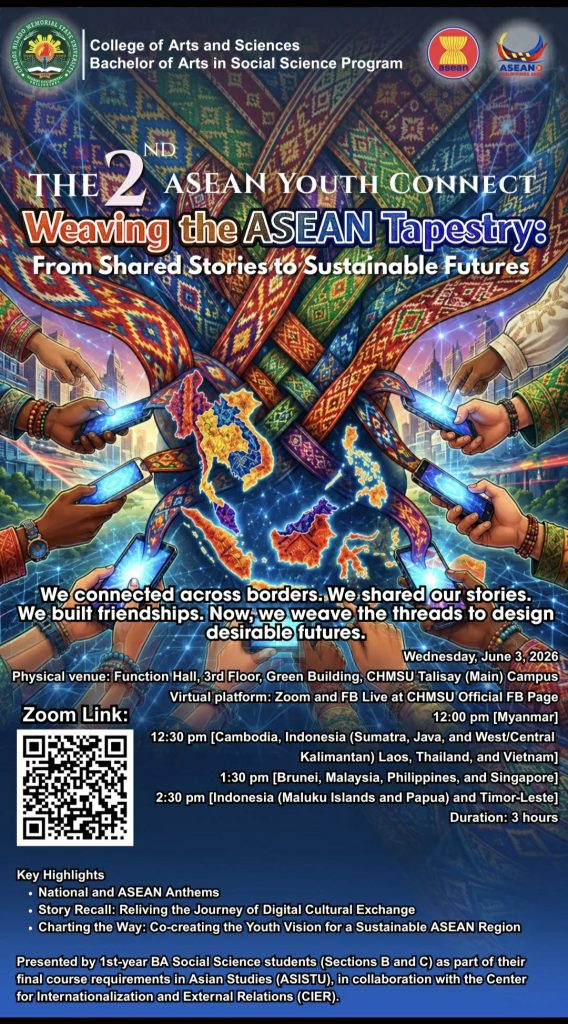
Carlos Hilado Memorial State University (CHMSU), through its College of Arts and Sciences — Bachelor of Arts in Social Science Program — will host the 2nd ASEAN Youth Connect on Wednesday, June 3, 2026, themed “Weaving the ASEAN Tapestry: From Shared Stories to Sustainable Futures.”
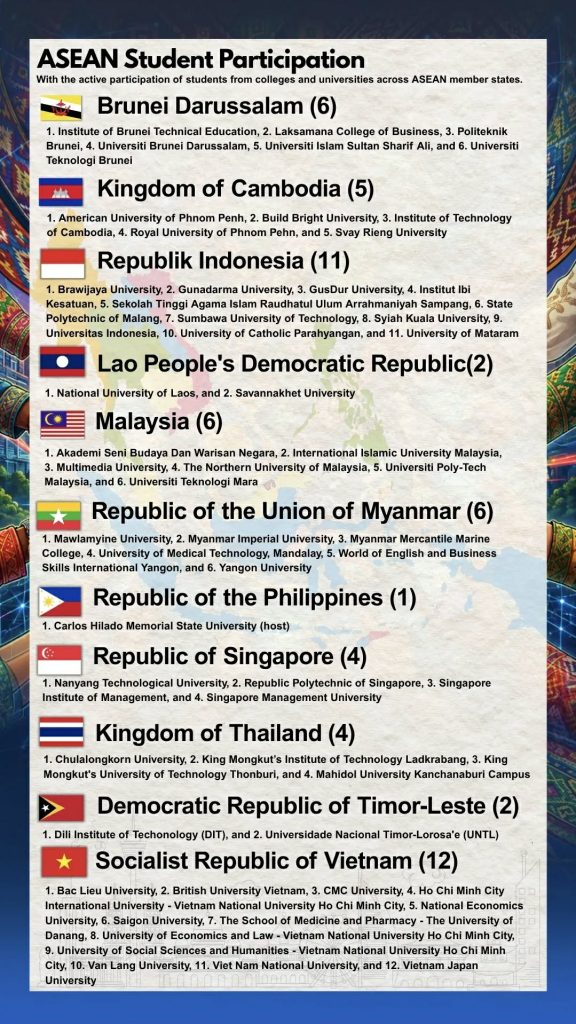
The summit will bring together students and youth representatives from 59 colleges and universities spanning all 11 ASEAN member states, making it one of the most expansive youth-led academic gatherings the region’s students have organized under a Philippine host institution.
The event will be conducted in a hybrid format, held simultaneously at the Function Hall, 3rd Floor, Green Building, CHMSU Talisay (Main) Campus, and broadcast via Zoom and Facebook Live through the CHMSU Official Facebook Page.
The 2nd ASEAN Youth Connect is presented by first-year Bachelor of Arts in Social Science students of CHMSU — specifically Sections B and C — as the culminating requirement of their course in Asian Studies (ASISTU) under CIER Director Rhoderick Samonte. The event is organized in collaboration with the Center for Internationalization and External Relations (CIER), reflecting CHMSU’s ongoing commitment to internationalization and the cultivation of globally aware, socially responsible graduates.
To accommodate the diverse time zones of participating nations, staggered connection times have been arranged. Myanmar (GMT+6:30) will log on at 12:00 noon; Cambodia, Indonesia’s western and central regions (Sumatra, Java, and West/Central Kalimantan), Laos, Thailand, and Vietnam — all at GMT+7 — will connect at 12:30 p.m.; Brunei, Malaysia, the Philippines, and Singapore (GMT+8) will join at 1:30 p.m.; and Indonesia’s eastern regions (Maluku Islands and Papua) together with Timor-Leste (GMT+9) will connect at 2:30 p.m. The full program is expected to run for three hours.
The 2nd ASEAN Youth Connect draws institutional participation from across the entire ASEAN bloc. Brunei Darussalam is represented by six universities, including the Institute of Brunei Technical Education and Universiti Brunei Darussalam. The Kingdom of Cambodia sends delegates from five institutions, among them the American University of Phnom Penh and the Royal University of Phnom Penh. Republik Indonesia contributes the largest single-country delegation alongside Vietnam, with 11 universities participating — from Brawijaya University and Universitas Indonesia to the University of Catholic Parahyangan and Sumbawa University of Technology.
The Lao People’s Democratic Republic joins with two universities — the National University of Laos and Savannakhet University — while Malaysia fields six institutions, including the International Islamic University Malaysia, Multimedia University, and Universiti Teknologi Mara. Myanmar’s six participating universities range from Mawlamyine University and Myanmar Imperial University to the University of Medical Technology, Mandalay. The Republic of Singapore sends four prominent institutions: Nanyang Technological University, Republic Polytechnic of Singapore, Singapore Institute of Management, and Singapore Management University.
Thailand contributes four universities, including Chulalongkorn University, Mahidol University Kanchanaburi Campus, and two King Mongkut’s institutes. Timor-Leste participates through the Dili Institute of Technology (DIT) and Universidade Nacional Timor-Lorosa’e (UNTL). Leading all nations in total participation, the Socialist Republic of Vietnam sends 12 institutions — from Bac Lieu University and the British University Vietnam to the University of Social Sciences and Humanities – Vietnam National University Ho Chi Minh City and Vietnam Japan University. The Philippines is represented by CHMSU itself, serving proudly as the host institution.
The summit’s program is structured around three key highlights. It will open with the singing of the National and ASEAN Anthems, affirming the shared identity and solidarity of all participating youth. This will be followed by Story Recall: Reliving the Journey of Digital Cultural Exchange, a reflective segment in which participants revisit the connections, friendships, and cultural discoveries forged during the first ASEAN Youth Connect.
The culminating activity, Charting the Way: Co-creating the Youth Vision for a Sustainable ASEAN Region, will challenge student delegates from across the region to collaboratively craft a unified youth vision addressing sustainability, inclusive development, and regional cooperation — translating shared stories into concrete aspirations for the ASEAN community’s future.